Posted by: Diana Cassar-Uhl, IBCLC | February 22, 2013

Breastfeeding with mammary hypoplasia/IGT: a study!


breastfeeding

One of our biggest frustrations in the lactation/breastfeeding support arena is that we have so little information to offer mothers who have a physiological barrier to breastfeeding — their bodies just don’t produce milk, even after other problems have been solved.  I described this condition in this post at KellyMom.com.

Penny Liberatos, Ph.D. (New York Medical College) and I have launched a study, and we need as many mothers with hypoplasia/insufficient glandular tissue as possible to participate. This is the first study to comprehensively investigate the histories and experiences of breastfeeding women with low milk production due to mammary hypoplasia/insufficient glandular tissue (IGT). We have full IRB approval and intend to publish our findings, which we hope will be used to provide information and education to those who support breastfeeding mothers, as well as to inform future study of this population. Please share this link with mothers you know who may have hypoplasia/IGT, and if you found this post because YOU think hypoplasia/IGT might be contributing to your breastfeeding difficulties, please participate!

http://www.surveymonkey.com/s/3GSGDCL

Thank you to everyone who has already completed the study — our first round of data analysis is underway.  The time and care that went into each response is evident and is immensely appreciated.

About these ads
Posted by: Diana Cassar-Uhl, IBCLC | September 24, 2012

Milksharing: a story of peace and healing


If you’ve visited my blog before, you know that I believe in human milk for human babies, and I have a deep understanding and empathy for those mothers who can’t or choose not to breastfeed their babies, for whatever reason.  This week, World Milksharing Week, offers a perfect opportunity to highlight a beautiful story of love and healing, of generosity and peace that have been made possible by the gifts of milk donors.

First, be sure to check out this comprehensive report about mother-to-mother milksharing, by Amber McCann, IBCLC, and, from the International Breastfeeding Journal, Milk sharing: from private practice to public pursuit.

Stephanie was heartbroken after her first baby, Isaiah, was born and she realized she couldn’t make enough milk to meet his nutritional needs and sustain his growth.  A condition called mammary hypoplasia/insufficient glandular tissue (IGT) made it so that she could only produce about 4 ounces of milk each day; she had to supplement Isaiah’s intake with something other than her own milk, and at the time, commercially-prepared baby milk (formula) was, as far as she knew, her only option.  “I knew there was such a thing as donor breastmilk, but I thought it was only for sick babies,” Stephanie explains.  “We supplemented with just about every formula under the sun,” Stephanie recalls.  Isaiah had an undiagnosed cow’s milk protein intolerance; watching him suffer, and knowing the cow’s milk-based formula was likely to blame was very difficult.  Stephanie felt as if her body had failed her baby, and every day, every supplemental feeding, the pain of this feeling was new.  “When I was pregnant again, I heard about mother-to-mother milk sharing on the IGT support page on Facebook and immediately knew this was what I wanted to do.”

Stephanie breastfeeding baby Elliot

The gift of donated milk fills more than the freezer, it fills the hearts of both the donor and recipient families.

During her pregnancy, Stephanie began visiting and posting her story to various mother-to-mother milksharing websites, such as Eats on Feets, Human Milk 4 Human Babies, and MilkShare.  She met profound empathy, generosity, and support in these online communities, and, over time, received donated milk from more than 10 mothers in 5 states – over 4000 ounces total.  Her first connection, however, was to a mother named Shelly.

Shelly lives an hour away from Stephanie, in southern Maine.  The first time she traveled to pick up the milk Shelly was donating to her and her baby, Elliot, Stephanie had to ask friends to loan her coolers – six of them – so they’d be able to keep all of the milk cold on the trip home.  “I couldn’t believe it!  Our 7 cubic-foot freezer was nearly full after that first donation!”  In her two trips to Shelly’s house, Stephanie acquired over 3000 ounces of milk.

The milk wasn’t all Shelly shared, however, and it wasn’t the only thing Stephanie and Elliot gained.  The two families became friendly, the dads enjoying each other’s company while the moms gathered Shelly’s milk and supervised their little ones, who, at the last pick-up, were delighted by an impromptu play-date.  “The connection was immediate, we clicked,” Stephanie says.  “It felt right.  The thought that a mother — and her child — would care so much as to aid us in our goals is truly heartwarming. The generosity that she has bestowed upon us leaves me in tears every time I think about it. We could never be grateful enough for the hearts of these mothers.”

Shelly with her children, left, with Stephanie and Elliot, right, at the last milk pick-up

For Stephanie, the ability to nourish Elliot on human milk alone meant a great deal to her, especially after her experience of watching Isaiah struggle with a substitute.  “No greater joy could I have than to know that, despite my severely low milk supply, my child is still able to exclusively receive the benefits of human milk. The healing that I have found with donor milk is more than I can put into words. The peace that Shelly, and all of the other wonderful donors, have given me is more than I could have ever imagined.”  Stephanie goes on to say that being able to fill an at-breast supplementer with “liquid love” (donor milk) and breastfeed Elliot, just like women without IGT do, has been life-changing for her.  “The healing I have found with this is incredible. IGT isn’t easy. There’s nothing easy about it. But what a blessing to have a nursing relationship in the first place, no matter how little I make! This has brought me so much peace.”  While her baby, now 16 months old, has weaned since about a month ago, Shelly continues to pump milk for Elliot, who is 7 months old now.  She shares in Stephanie’s desire to provide human milk through Elliot’s first year, and feels the joy of the impact she is making in Elliot’s life.

Even after that year goes by, Stephanie knows that Shelly and the other mothers who have assisted with her breastfeeding journey will hold a permanent place in her family’s heart.  She hopes her friendship with Shelly will be enduring as their children grow up and breastfeeding becomes a memory for both families.  Stephanie says “I will forever be indebted to Shelly and the other mothers who have donated their milk, time, and love.  Their giving hearts have changed my life. Shelly has helped us defy all odds. She is amazing and I am blessed having her in my life. I will never take for granted all that she has done for us. Calling her a milk donor will never be honorable enough … these moms are superheroes.”

If you have milk to donate, you have options.  Milk banks in the United States are always eager to accept milk donations, but certain requirements, such as the age of your baby, must be met.  Read more about donating to an HMBANA milk bank. 

If you’d like to share your milk with a mother and baby in need and you don’t meet the requirements for donation to a milk bank, or you would prefer a mother-to-mother arrangement, visit any of the milksharing websites that were linked above.  Be sure to adequately inform yourself and examine the risks and the benefits of feeding your baby donated human milk, and determine whether the benefits outweigh the risks for your situation and your baby.  

Posted by: Diana Cassar-Uhl, IBCLC | August 14, 2012

When the media spins the biological norm


I am often asked, through networks of professionals, to connect a reporter or media representative to breastfeeding mothers in a particular situation.  There are some requests that I scramble to satisfy, without reservation, because either the journalist is one whose work I am familiar with (and is truly supportive of breastfeeding), or because the population they are looking for is one that can benefit from exposure.  I’m all for raising awareness and bringing less-known breastfeeding topics into the cultural mainstream.

This week, however, a request began circulating that didn’t really pass my “sniff test.”  A newsmagazine-type TV show here in the United States put out a call for help with a story about breastfeeding, which would include information about New York City’s initiative to halt formula marketing on hospital mother-baby wards.  They sought mothers who have used or who have considered using pharmaceuticals, off-label (for a purpose other than what it was approved to treat), to stimulate milk production.  The title of the piece, along the lines of “Breastfeeding – Are We Going to Extremes?” got my antennae up immediately, and had the same effect on some of my colleagues.  The very title of this blog, normal, like breathing, speaks to this frustration, as I commented here … are we “extreme” when we get a cast to re-set a broken bone?  Is a kidney transplant “extreme” when someone’s kidneys don’t work?  Is an inhaler “extreme” when a person can’t breathe otherwise?  Why is a mother who takes measures to approximate, as closely as possible for her, the normal, physiological process of breastfeeding relegated into the “extreme” pile?

There are two populations who offer prime subjects for this request: adoptive mothers who wish to induce lactation and offer feedings at the breast, and mothers with chronic low milk production, such as those with hypoplasia/insufficient glandular tissue.  Given that I work closely with the latter population (which comprises a relatively small percentage of breastfeeding mothers), I was in a position to “recruit” mothers for this media piece.  My first concern was for the protection of these mothers.  One drug, called Domperidone (Motillium) was originally developed as an antiemetic/anti-nausea drug, but a side effect is … lactation! Domperidone works as a dopamine antagonist, and like for most endocrinological processes, blocking the action of a neurotransmitter sets off a domino effect – in this case, the result is sustained, increased levels of prolactin.  It seems easy enough:  some mothers need a little help making enough milk for their babies, Domperidone offers that help.  But!  Domperidone is not approved for sale or use in the United States and is currently under “orphan drug status” while researchers study how it works to support lactation, whether long-term use is without risk, and whether the high doses used to induce or support lactation are, indeed, safe for mothers and babies.  I did not feel comfortable sending a mother who is currently using Domperidone into the hands of a reporter who is attempting to determine whether she is “going to extremes.” A few of my colleagues and I were comfortable offering lots of expert voices, though – esteemed members of our field who could provide the facts about off-label pharmaceutical use for lactation support.  The producers were also directed to the Academy of Breastfeeding Medicine’s protocol on the use of galactagogues, which clearly states that these are last-resort measures to be called upon after all other possible causes for low milk production (breastfeeding management, anatomical issues in baby that preclude milk transfer, hormonal issues in mother that preclude milk production) are ruled out.  It is also important to recognize that IBCLCs cannot and do not act in a prescribing capacity, unless they are otherwise licensed or credentialed (MD, DO, RN, CNM, FNP, etc.) to do so.  While an IBCLC might provide information about Domperidone and other evidence-based measures of augmenting milk production to a mother who might benefit from them, she is NOT “prescribing” anything.

The producers of this show didn’t seem too interested in getting the facts, though.  One mother, who had successfully used Domperidone earlier in her breastfeeding (with insufficient glandular tissue) journey, felt safe sharing her experience. She spoke with a representative from the show and was told “we really want someone who is using it right now.” Hmm.  Another (media-savvy) mother shared her balanced, not-particularly-extreme experience of using Domperidone to support her breastfeeding experience, and was dismissed – asked instead, “Do you know anyone who has had a bad experience with it?”  Hmm again.  We offered to find a mother in Canada who is using Domperidone (there are no regulatory concerns in Canada or many other countries; Domperidone is prescribed by appropriately-licensed healthcare providers and used by mothers for lactation support), but the interest is in mothers in the United States.  You know, the ones who are “going to extremes to breastfeed.”

Our collective radar piqued, we were especially interested in a blog post at the website “Moms Feeding Freedom” (punctuation theirs) that was published yesterday (August 13), because it contained many of the elements that were being proposed for this newsmagazine program’s piece. It is interesting to note, on the blog’s “about us” page, this statement: “MomsFeedingFreedom.com was made possible by a grant from the International Formula Council.” Needless to say, the blog post cites a “troubling trend” and describes mothers going to “extreme lengths” in order to breastfeed.  Hmm.

It is pretty obvious to me that this newsmagazine is NOT seeking to present a balanced look at mothers who work incredibly hard to provide human milk to their babies, rather, it is seeking to produce, in made-for-TV form, a sensationalized, flame-fanning piece that echoes the blog post on “Moms Feeding Freedom”.

Some of these mothers turn to herbal and pharmacological galactagogues to boost their own milk production, others need to supplement so their babies can grow.  What goes in the supplementer?  Well, there are some who think that’s an issue of “extremes,” too, but fortunately, the cultural opposition to human milk for human babies, either milk collected by milk banks and dispensed by prescription to babies in need, or milk acquired by mother-to-mother milk sharing, is dwindling fast.  Of course, there are mothers who, upon learning their own bodies won’t be able to completely nourish their babies, choose to supplement whatever breastfeeding they can do with artificial baby milk – and there are others who decide they just plain don’t want to or can’t breastfeed at all, so they switch immediately to bottle-feeding without looking back.  These mothers aren’t any less loving, intelligent, or devoted to their babies than the ones who do seek to make breastfeeding work.  The very existence of mothers who prioritize breastfeeding as part of their mothering experience does not lessen or cheapen the choice of mothers who opt not to.

I am publishing this blog post to raise awareness of the measures the media (perhaps funded by WHO Code-violating sponsors?) will take to marginalize mothers who go the extra mile to breastfeed their babies.  These mothers have, frankly, been through enough upon discovery that their bodies don’t do what they expected them to do; and the availability of assistance to preserve a breastfeeding relationship does not discredit mothers who choose not to take advantage of that assistance, rather, it allows for true freedom of informed choice for all mothers.  I have worked with countless mothers who did not produce all the milk their babies needed, but who valued what milk they could offer, or rejoiced in the ability to feed their babies at their breasts rather than by bottle.  These are mothers for whom breastfeeding was so much a part of what they anticipated about mothering, mothers who learned to accept their limitations and work with them to whatever capacity they wanted or could.  Mothering success is not measured in ounces – or drops – of milk that flow from breast to mouth, it’s measured in the love that flows between a mother and her baby.  For some mothers, embracing, as far as is possible, the biological norm for infant feeding and nurturing is what comes most easily – the oxytocin and prolactin bursts that accompany feeding at the breast and the triumph over obstacles that others may consider insurmountable offer more than adequate compensation to the family that goes the extra mile to breastfeed in the face of difficulties.

Shame on anyone who seeks to malign or marginalize these brave, devoted mothers.  They’re not “going to extremes,” they’re taking reasonable measures to make a normal process work.

For more images of mothers and babies who have overcome obstacles to make breastfeeding work for them, see this beautiful YouTube video by Melissa, a mother with hypoplasia/IGT.

Posted by: Diana Cassar-Uhl, IBCLC | August 8, 2012

The surgeon who changed my life


Well, no, it’s not really like that.  I wasn’t sick, and the “changing” part was that the guy refused to operate on me.  At the time, I was kind of mad about it.

I was 26, and in the best shape of my life having just run my first marathon. I loved running and spent a lot of time in the gym, too.  At my well-woman check-up, the Nurse Practitioner took one look at my chest – the entire perimeter of my body where my sports bras touched me was chafed and oozing.  Shoulders, underarms, all around my ribcage were just wrecked.  Even at 125 pounds (ah, youth!), my breasts were still an ample 34DD, and I struggled with back/neck/shoulder pain, deep grooves in my shoulders, and chafing was part of my existence.

On the beach, weeks after meeting with that surgeon

“Why on earth have you not had those things reduced?” she asked me during my breast exam, obviously disgusted by the scabs and glossy, exposed skin. (I feel compelled to mention that this woman is still practicing around here, and I’m told she still says such horrific things, but at that time, I was just happy to have a civilian female as my primary care provider.)  Honestly, it hadn’t really occurred to me that I would be a candidate for a breast reduction, other than that I wished I could wear cute, sleeveless dresses or tank tops that showed off my fit arms.  Surgery hadn’t seemed feasible until then.

“Um, I don’t know?” I answered, feebly.  She put in a referral for me to see a surgeon, which immediately led to another referral to the plastic surgery clinic at Walter Reed Army Medical Center.  The year was 1999.  I was sent on medical TDY from New York to Washington, via the Delta Shuttle out of LaGuardia with a bunch of businessmen.  I don’t remember much about getting to Walter Reed from the airport, except that it was scary.  The hospital was old and tired.  I found the plastic surgery clinic and sheepishly presented myself for my appointment.

I don’t remember the doctor’s name.  I remember that he was from North Carolina, and his accent was pretty thick.  I remember that he drew with black marker on my breasts and chest, and took pictures and notes, and didn’t say a whole lot while he was doing that.   There were Xs and lines and circles and arrows all over my upper body.  I remember that I felt really weird sitting there in a medical setting, with my visions of sleeveless dresses but knowing this was more about finding a solution for my chronic shoulder pain and the awful chafing.  And I remember what he said when he finally spoke to me after his assessment.

“Have you had any babies?” he asked me.

“Um, no.  I don’t even have a boyfriend right now.”

“So you think you might have babies someday?” he went on.  Why does this matter?  Do I get my breast reduction or not?

“I don’t really know … probably.  Yeah, I hope I have babies someday.”

“Look,” he spoke quickly, but with his North Carolina twang.  “When you get pregnant, your breasts are going to go south.  They all do, from the pregnancy.  So do me a favor – have your babies, and breastfeed them if you want to.  Then, when you’re all done, and your breasts have gone south, come back and see me, and I’ll make you the envy of all your friends, because you’re actually a candidate for a breast reduction, but they won’t be.  Come back when you’re done using your breasts.”

I was shocked, and a little embarrassed.  I had only ever seen one baby breastfeeding up close, and breastfeeding was the last thing on my mind at that point in my life.  I think my disappointment showed on my face, and the surgeon spoke again.

“I’ve done 687 breast reductions in my career, and only two have been on women who weren’t done having babies yet.”  He went on to tell me about those girls – one, a teen with such severely large breasts, she needed to secure herself with duct tape just to get out to the door to school.  “She would have been an L-cup,” he told me.  I don’t remember what he said about the second case because I was lost in thought about how this guy probably changed that poor young girl’s life … for the better … but it had become clear he wasn’t planning to change mine, at least in the way I was seeking.

I left the clinic and rode the Delta Shuttle with the businessmen back to LaGuardia airport, sad to deliver the news to my friends that I wasn’t going to have a breast reduction after all, and I wouldn’t get to wear cute tops and dresses, and I’d still be sore and chafed.

Because the surgeon wanted to make sure I had the opportunity to breastfeed someday.

Now, there are women who have breast reductions and go on to breastfeed.  My friend and colleague Diana West, IBCLC wrote about them in her book Defining Your Own Success: Breastfeeding After Breast Reduction Surgery and has been educating women and healthcare providers about breastfeeding after surgery for over a decade.  I didn’t know about these women in 1999.  I didn’t really care in 1999.

She was about 4 months old here — so sweet.

In December of 2002, I gave birth to my first baby.  I had read books and prepared to breastfeed her, but it wasn’t until we had major problems doing so that my commitment to nursing Anna was solidified (yeah, I’m one of those people who likes to do things that someone tells me I can’t do, so on our 5th day in the hospital, when that nurse said “you can always just pump and bottle-feed,” it was game on and there was no flat or inverted nipple, no bilirubin of 22, no return to work, no nothing that was going to keep me from breastfeeding).  I stayed committed through 105 fever and severe mastitis on my 8th day (while my husband was gone the entire day and night playing a gig with Tommy Tune in NYC); I stayed committed through Anna’s bloody diapers and bad, bad guidance from our pediatrician; I stayed committed at 3 weeks when Anna refused to sleep for more than 45 minutes at a time, happy only when I nursed her, as I hissed to her half-sleeping daddy at 2 in the morning, “I know why people quit this.”

At some point, the dust settled.  Maybe it wasn’t even until after my second baby was born – I honestly don’t remember when it happened for me, that feeling of empowerment, of knowing that I was doing something for my baby that countless women before me had done for theirs, something only I could do for mine.  I discovered somewhere along the way that breastfeeding wasn’t only about what I fed my baby, but about how I mothered her and how she learned to relate to me.  The God-given potential of my big, unwieldy breasts – even bigger and more unwieldy now after three pregnancies and nearly a decade of lactation had been fulfilled.

She was always happy there … I was home base.

I don’t know the name of that North Carolina plastic surgeon who worked at Walter Reed Army Medical Center in the summer of 1999, but there isn’t a single day that I don’t think about him with a thankful heart.  The experience of breastfeeding has been a life-defining one for me, leading, of course, to my becoming a La Leche League Leader, an IBCLC, and now working toward a Master’s Degree in Public Health.  I aspire to study epidemiology next, and to spend the rest of my working life conducting and publishing research about breastfeeding, with the hope that my life’s work can enable more mothers to be empowered by their experience of breastfeeding.  If you had told me in 1999 that breastfeeding, mothering, epidemiology – any of this – would be my sweet spot, my calling, I would have laughed at you.

Would I have breastfed my own children after reduction surgery?  Possibly, but given the woefully substandard breastfeeding support where I received my medical care and the fact that no women in my family had positive breastfeeding stories to share, I don’t know what lengths I might have gone to in order to make it work if the obstacles had been any bigger than the ones I faced.

Today, I am 39, with a strong enough history of breast cancer to spur some healthcare providers to talk to me about a prophylactic double-mastectomy and breast reconstruction.  If determined beneficial by genetic tests for BRCA1 and BRCA2, I could, perhaps, be a candidate for a surgery that could prevent cancer and give me the chance to go sleeveless at long last.  Now, though, I’m ambivalent.  I struggle with whether I could really part with this assemblage of glandular and fatty tissue that has played such a significant role in the lives of my children and me.  What if I ever needed to lactate for a grandbaby — or if one of my children grew up and got sick, and I could help by re-lactating and providing human milk again?  Such considerations don’t occur to most people, for whom breastfeeding is a small part of their history, but for me, they are huge.

My answers will come, or perhaps the big decisions will be made outside of my control — like the 1999 decision of an Army plastic surgeon that changed my life.

Posted by: Diana Cassar-Uhl, IBCLC | June 15, 2012

Understanding oversupply


Oversupply, forceful let-down, foremilk/hindmilk imbalance … all of these strike fear in the heart of new mothers because they translate to an inconsolable, visibly uncomfortable, crying baby.  He may want to nurse all the time, because the sucking behavior soothes him when his tummy hurts, but the more he nurses, the more miserable he becomes.  There may be blood in his diapers, maybe he chokes when he starts breastfeeding, or he spits up a lot after every feeding.  You’re desperate for a solution that won’t threaten your milk production, because you really want to continue breastfeeding your baby – but your baby doesn’t seem to “like breastfeeding” and you’re feeling rejected and discouraged.  What causes this constellation of circumstances?  There is a lot of information out there about oversupply, overactive milk-ejection reflex (OAMER), and what has been called foremilk/hindmilk imbalance. I will do my best to help you understand WHY your breasts are so eager, WHY this is so irritating to your sweet baby, and offer you some resources for how to find the solution that works for you and your baby.

First, it is very important that you ensure your breastfeeding management is optimal and you are “watching baby, not the clock.”  Some mothers unintentionally create an overproduction of breastmilk when they, perhaps out of concern that they’ll make enough milk, or maybe to make bottles so grandma and daddy can feed the baby, pump or express more milk than their babies are actually taking.  Most mothers, if feeding on demand and not by a schedule, and not over-stimulating milk production, will make the milk their babies need.  Hormonal imbalances are another reason for overproduction of milk; if you have a history of PCOS, you may be susceptible to oversupply.  Postpartum thyroid issues can also have an effect on milk production.  Be sure to rule out medical causes of hyperlactation first.

You may have been told that your baby is fussy, has a skin rash, is gassy, spits up, has diaper rash, a red ring around his anus, or green poop because of something you’re eating, oversupply, or foremilk/hindmilk imbalance.  You may also be hearing that “gassy foods make gassy babies” when you’re breastfeeding, and you’re confused and concerned that you will have to somehow satisfy your ravenous appetite on salad and air.

A note about how you make milk:  your milk is synthesized from ingredients in your bloodstream, not in your digestive tract.  Gassy baby after that stir-fry?  It probably wasn’t the broccoli …  yet, you’ve read something or someone has told you that eliminating certain foods from your diet may be the answer to your crying, uncomfortable baby.  How can this be possible?

A healthy, mature digestive tract (or “gut”) is “sealed;” nutrients are absorbed and wastes are contained until they are eliminated.  This “sealing” takes place in a healthy, breastfed baby sometime around the middle of the first year (immunoglobulin from your milk helps to coat your baby’s small intestine in the meantime), which is why it is advised that we hold off on introducing solid foods until then; also, the first foods we introduce are hopefully less likely to be allergenic and irritating to your baby’s gut.  This is where the claims that breastfeeding protects babies from allergies and eczema come from, IF our own (maternal) gut is healthy.

For many of us, though, our gut is not healthy and sealed, and is known as a “leaky gut.”  Perhaps we were formula fed as babies, or we’ve been on antibiotics; maybe we have a food allergy or intolerance we don’t know about, or our diets are full of processed, irritating ingredients we’ve been led to believe are “foods” because we can buy them in the grocery store … whatever the reason, our bodies mistakenly allow proteins from foods we eat to pass into the bloodstream, where they can then pass into your milk.  So, if your gut is leaky or less healthy than ideal, irritating proteins are passing into your milk and being fed to your baby, creating many of the same symptoms commonly seen in babies fed cow’s milk or soy preparations: eczema, gas, diaper rashes, and later, reactions or sensitivity to allergenic foods.

A Google search or a Facebook page may tell you your baby’s problems are caused by foremilk/hindmilk imbalance.  This was once a commonly accepted explanation and “block feeding” (offering the same breast at every feed for a prescribed number of hours, then offering the other breast for the same number of hours, regardless of how many times the baby wants to feed in that time) was the preferred method for dialing down milk production and encouraging the baby to consume the fatty, satisfying “hindmilk.”  Now, however, the idea that a mother makes two different kinds of milk is being challenged and the practice of block nursing doesn’t seem so vital.  Nancy Mohrbacher, IBCLC, FILCA published this blog post on the foremilk/hindmilk misconception and what current research tells us.

Today, we are also thankful that the Academy of Breastfeeding Medicine Clinical Protocol #24 is available to us: Allergic Proctocolitis in the Exclusively Breastfed Infant.

From this, we learn that an exclusively breastfed baby can experience allergic symptoms as a result of maternal intake.  Cow’s milk is the primary offender cited, and this is consistent with my clinical experience.  All of the mothers I have worked with who had symptomatic babies reported some, if not complete, improvement after eliminating dairy products from their diet.  Other mothers needed to eliminate soy, eggs, and/or gluten to bring their babies to complete relief.  Some very detailed analyses of gut health, with some commentary on breastfeeding mothers and babies, can be found at this link.

Does this even relate to oversupply?  If so, how?  It’s clear that the symptoms in babies are similar.  Some professionals suspect a cause and effect relationship, that something about the mother’s gut health causes both oversupply AND allergic sensitivity in the breastfed baby.  There is no current, specific research linking maternal gut health to oversupply, but it has been my experience that most mothers with oversupply also have babies with allergic reactions to something in their milk. (Tongue tie in the baby is also very often present, but this goes beyond the scope of this post.) To me, this suggests that the mother’s digestive issues (which she may or may not be aware of – she may feel perfectly healthy and well), can result in a host of abnormal outcomes, among them oversupply and forceful let-down.  While not “evidence-based practice,” rather, “practice-based evidence,” I’ve noticed over the last 7 years that the mothers who eliminated one or more allergens from their diets were delighted not only with their happier babies and normalized milk production, but with how terrific they felt without the allergen!  Caring for a newborn and feeling terrific!  Years later, many of these mothers tell me they never went back to the offending ingredient, or introduced it in far reduced amounts once their babies got older and/or weaned.

Do you see yourself and your baby in this post, but feel discouraged because you just went through a pregnancy where you couldn’t drink alcohol or caffeine, eat sushi, soft cheeses, or deli sandwiches, or enjoy a medium rare steak?  It may feel unfair that now, you need to give up ice cream, cereal with milk, and your favorite candy bar (read the label, it has soy in it!).  Don’t worry!  There are so many wonderful foods you can eat!  I’ve written on my blog about delicious, wholesome, healthful, real foods that won’t make your baby cry in pain.

Of course, you may choose to try other measures to resolve oversupply before changing your diet.  If you’ve already ruled out possible medical reasons for hyperlactation, changing your breastfeeding position to one that makes the milk flow against gravity is one (side-lying and “laid-back” are two options) measure that is gaining popularity.  “Block feeding” is still commonly recommended, but some IBCLC’s report that the method is either incorrectly communicated or not well understood, and mothers can jeopardize their milk production capability if they are not closely monitored during the block feeding period.   If your IBCLC suggests block nursing, be sure to ask her to be specific about how long each block should be, and for how long you should continue the regimen.  Antihistamines, sage, and mint (for example, tea made from steeping fresh mint leaves) are also ways to reduce milk production.  These methods, however successful they may be, represent a resolution of the symptoms, not of the cause, therefore, even if the oversupply is corrected, sensitivities may still persist in your baby.

If you are having breastfeeding problems related to oversupply or forceful let-down, consult an IBCLC.  If you would like to speak with an IBCLC who specializes in the maternal health connection to breastfeeding and healthy babies, Jennifer Tow, IBCLC at http://holisticibclc.blogspot.com offers individualized consultations, via Skype, to help you assess whether your breastfeeding issues are related to your health or diet and develop solutions that will improve your health and the health of your baby.  She also offers workshops for mothers and healthcare professionals – see her site for more details.

Breastfeeding your baby can be a pleasurable, memorable experience, definitely worthy of any adjustments you may make to ensure your baby’s health and comfort.  The best news:  there are resources for you, and you will find solutions that work for you and your baby.

Posted by: Diana Cassar-Uhl, IBCLC | May 31, 2012

I breastfed in uniform


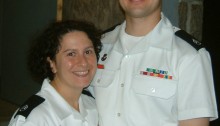
I didn’t think I was going to jump into this conversation, because I sometimes feel like my 17-year military career has been atypical enough that I shouldn’t bother telling people I’ve served.  I used to be in the Army.  I spent my entire career as a clarinet player (among other things, but that was my main job) in a Special Band.  I won my job as I was finishing my undergraduate degree in clarinet performance, and it was a great gig.

My official photo in 2000, before marriage or children (closely cropped because I’m not savvy enough to edit the text in the top left).

The media hubbub about the photo of the two Air Force mothers breastfeeding their babies … you know what I’m talking about.  One’s nursing twin girls and the other’s got a toddler across her lap.  It’s a gorgeous photo, but, like the now-infamous TIME cover that not-so-accurately portrayed a breastfeeding 3-year old, it isn’t really a good illustration of what “breastfeeding in uniform” actually looks like.  A lovely image of the mothers who were part of a photo shoot, sure, but not what we should be basing our judgements on about the behavior in general!  My friend Robin Roche-Paull, author of Breastfeeding in Combat Boots, shared it with her community of followers, and over the Memorial Day weekend, it went viral.

Of course, it was a conversation-starter, and that meant people publicly proclaimed the aspects of that photo that made them uncomfortable.  I confess, my very initial reaction upon seeing it was a slightly uncomfortable “whoa,” which I’ll explain in a minute.

I breastfed my children for more than half of my Army career – many of my own stories are represented on this blog.  Yet, for all those years breastfeeding, I have NO pictures of me doing it in uniform.  Not a single one.  In fact, I don’t have any photos of me in uniform with my children.

At the Mormon Tabernacle — my 7-month old baby was in her daddy’s arms just offstage.

I breastfed in every uniform I ever had to wear.  Untucking the t-shirt from the shorts on the APFU, unbuttoning the bottom of the weskit shirt in Class B’s, unzipping my high-collar concert coat (under which was a a cami or tee) to soothe a fussy baby on the hallway floor of a high school during a long concert’s intermission.  ACU’s were harder to get back together than other uniforms after breastfeeding or pumping, but I did what I had to do.

The Sierra uniform was the worst – that was my summer concert uniform.  My babies loved to grab at the ribbons and insignia while they breastfed, sometimes hard enough to dislodge a “dammit” backing, forcing me to scramble to either find a spare or maybe a folded up piece of cardboard so my ribbon would sit straight during the concert and not stab me.  It was easy enough to leave the stiff white shirt tucked into the who-thought-this-fabric-was-good-for-a-summer-short-skirt and unbutton a few of the bottom buttons to breastfeed discreetly, but in 94-degree heat, feeling like my pantyhose were melting onto my legs and desperately hoping my 6-month old fussy baby would settle enough to nurse before I had to take the stage, I was more worried about the position of my legs so I wasn’t flashing my underwear at the people setting up their lawn chairs and blankets for the concert that was going to start in … how many minutes do I have?  Come ON, baby, this is your last chance and there’s nowhere for you and your caregiver to go to escape this heat, unless you want to go to the car and turn on the air conditioner?  Who has the car keys?  (My husband is still in the unit I’m leaving.  This was all a family endeavor.)  He has the keys?  He’s already on stage?  Aaagh …

Sharing a solo feature — our two (at the time) children listened from the audience.

And it dawns on me, why I have no photos of me in uniform with my children.  I was already juggling so much– making sure our caregiver went to the bathroom before the concert started, were there enough diapers and snacks in the bag?  Are the people seated near my three young children planning to smoke during the concert?  Will our NCOIC try again to tell us we “shouldn’t” have our children at our concerts (but the ill-behaved brats that are running, yelling, and playing with a beach ball over there, next to the stage are of no concern)?  Will the fireworks make my babies cry?  Will the music be too loud?  Will their happy dancing irritate the concertgoers around them?

And, oh yeah.  I’m about to take the stage now and perform an eclectic program of challenging music with the highest level of musicianship my years of study have prepared me for, while smiling and looking the part of the military ambassador to our public that I am.  Was.

“So don’t bring your kids with you,” people would say (behind my back, rarely to my face).  Maybe that’s possible for some, but a 2-hour concert often meant a 9-hour workday, usually on a weekend or holiday, and my babies didn’t take bottles.  Could I have “forced them to” like some people suggested, leaving a caregiver stuck in my house with a screaming, inconsolable baby when the alternative is to enjoy a concert with a satisfied, happy baby who sees his mother right there on stage?

Sometimes, they would fall asleep before the concert ended.

I don’t want photos of myself breastfeeding in uniform.  I don’t want to remember planning my pregnancies around our busy seasons so that long, unavoidable separations would happen when my babies could handle them better.  I don’t want a scrapbook page of pumping at first aid stations (or being turned away from them and forced to find a less suitable place); of finding dead bugs belly-up in a Montana hotel with 2 children and an au pair in tow; of appointments with the Staff Judge Advocate to have my rights explained to me because someone in my chain of command wanted to call our overnight trips “deployments” when they were actually “temporary duty” (TDY) and governed by a different set of expectations; of the ignoramus outside my locker room door asking how long I’m going to be pumping on our 20-minute break because he had to ask me a question (that was just as easily asked when rehearsal ended or before it started).

I know how fortunate I am that I never had to separate from my children for weeks or months at a time; that I never had to go into harm’s way; that what I went through to provide my milk to my babies was mundane compared to what so many mothers surmount; that my children had some really positive experiences because their parents were professional musicians and professional Soldiers.  (How many 4-year olds do you know that snap to their feet and put their hand over their hearts when the National Anthem starts?  Do they know the words?)

My two older children, left and right, with their best friend (and daughter of their caregiver for the evening, center) — having fun before the concert started!

I did have to work in a male-dominated environment, complete with the jokes and childish behavior that accompanies breastfeeding and pumping at work (until they started getting married and having babies who needed help breastfeeding).  Motherhood – heck, parenthood – is seen as a liability, not only where I worked, but throughout our culture.  Breastfeeding is seen as a choice a military mother makes – but if she makes it, she’s perceived as not putting the mission first (whether or not that’s actually true), and in a culture that values the mission above all else, even the most outstanding contributor will find herself cast out.

I want to forget all of it.

My “whoa” reaction to the photo-gone-viral:  the women are outside in utility uniforms with no headgear.  If discretion was desired, the mom of twins could have adjusted her uniform to provide it.  If (heaven forbid) this photo is to drive policy, it can hurt the future for women in uniform, and I say again – this is NOT how breastfeeding in uniform really looks — at least it didn’t for me or the breastfeeding Soldiers I worked with.

When we expect/direct a sector of our population to “cover up” or somehow hide that they nurture their babies in accordance with the biological norm, we are not making a statement about that sector of the population — we’re making a statement about the biologically normal behavior.  Teachers are professionals, too. Should they not breastfeed in their teaching clothes? What about chefs? Or dentists? Is it OK for a discount store employee to nurse her visiting baby in her smock? What about a nurse in her scrubs, picking up her baby from daycare after a 12-hour shift?  Are they disgracing their respective professions?  Perhaps the public’s “whoa” reaction relates to this question:  are we still, as a culture, trying to deny that femininity — BEING FEMALE — exists in and augments our military?  Does seeing a breastfeeding mother in a uniform rouse something in you that you can’t reconcile with your ingrained beliefs?

Posted by: Diana Cassar-Uhl, IBCLC | May 25, 2012

Forgiving ourselves and the truth about breastfeeding


I haven’t met a single person who enjoys “the mommy wars.”  I’d go so far to say I even despise the WORDS describing this us vs. them concept that has permeated our culture.  Let me cut to the chase:  mothers who parent differently from me are not my problem.  The culture that makes the biological norm seem like the more difficult, less convenient, unrealistic, extreme choice is my problem.  Cultural constructs, ranging from an uninformed father to the deeply-rooted misogyny of a supervisor in the workplace that make  the biological norm NOT the best choice, are my problem.

There are far too many of these constructs, and as long as there is money to be made for every mother who does not breastfeed, the fight to eliminate those barriers to the biological norm will be a messy one … especially if we burn half our ammunition fighting against each other.

I’ve been reading and listening to a lot of Brene Brown.  She’s a psychologist who has spent several years researching, essentially, what distinguishes people who live connected, loving lives from those who don’t.  She finds that vulnerability, allowing oneself to be seen, is one key to experiencing what she describes as “wholeheartedness,” and that shame is the ingredient that prevents vulnerablity/wholeheartedness/authenticity. She says that love and belonging are available to those who believe they’re worthy of love and belonging. (I can’t even begin to summarize the significance of her work in one paragraph, so I urge you to take 25 minutes today and 25 minutes tomorrow and listen to these two TED talks by Brene Brown … they’ve changed how I look at everything.)  The Power of Vulnerability     Listening to Shame

What is most fascinating to me about what Brene Brown has uncovered is that, when we aren’t wholehearted and authentic, when we’re failing to confront our shame, we become toxic.  Cutting down others who make different choices from our own is toxic.  Being unable to see our own shortcomings is toxic.  Believing we are only “enough” if we can check all the boxes and be someone else’s definition of perfect is toxic.

I started my blog with the goal of normalizing breastfeeding in American cultureI defined normal, and contrasted it against the alternatives.  I also acknowledged that, even in the absence of barriers, some can’t and some don’t want to.  In our culture, the alternative has become preferable to the norm — bottle-feeding is the cultural norm.  Thanks to the information age, we are at no loss for the latest research, opinion piece, or controversy, whether from the comfort of our homes, on the go with our smartphones, or wherever we are.  The myths and misinformation get dressed up as studies or passed along as fact by the self-appointed authority of the day.

“Pacifiers won’t interfere with breastfeeding.”

“Breastfeeding mothers don’t contribute to society.”

“Breastfeeding an older child makes him dependent.”

“Sleeping with your baby is dangerous.”

“It’s unrealistic to expect today’s mothers to breastfeed exclusively for 6 months.”

It can all get deafening in a hurry, leaving us insecure, defensive, and ready to attack anyone who challenges the decisions we finally come to in all the noise, because we’ve embraced cultural norms that are at odds with our biological norms.

The mother with insufficient glandular tissue whose breasts didn’t develop enough for her to exclusively feed her baby isn’t going to let him starve because supplementation isn’t biologically normal.

The mother who carries the health insurance for her family isn’t going to quit her job because feeding expressed breastmilk by bottle isn’t biologically normal.

The mother who quit breastfeeding her twins before they were two weeks old because no one in her immediate support network thought breastfeeding was important or necessary (because they hadn’t breastfed any of their babies, either) isn’t supposed to berate herself for the rest of her babies’ first year because she’s buying, mixing, and feeding an alternative to the biological norm.

Yet, rather than taking a deep breath and acknowledging that we did the best we could with the choices we believed we had under the circumstances we faced, we struggle with whether we’ve done enough – and frankly, the notion that we’ve done anything less than 100% for our children is just too painful to bear.  The shame that we might not have “done enough” takes our breath away.  We sweep it under the carpet, or more likely, we undermine those who somehow accomplished what we felt to be impossible – we scoff at “supermom” and imagine she’s the unattainable ideal, or we consider her choices not worth it – knowing nothing about her story or what drove her decisions.  There are winners and there are losers.  There are haves and have-nots.

I’d like to think there’s another way, and it starts with first accepting that we do the best we can in the situations we’re in, and forgiving ourselves when a booby trap (thanks, Best for Babes) interferes with our efforts to breastfeed.

But, in our noble efforts ensure that no mother feels like she hasn’t done enough, we are making a grave mistake.  We tiptoe around the importance of the biological norm in birth, infant feeding, and care.  We say “breastfeeding is a personal choice,” but do we spend enough energy understanding why the alternative is attractive?  Instead of saying “my kid is healthy, so don’t try to make me feel guilty,” why can’t we say “I chose an alternative, but I did so after weighing the risks and the benefits to my family?”

When we are dismissive of breastfeeding as the biological norm, touting it as a “lifestyle choice,” that mother with the hypoplastic breasts won’t feel like demanding a full explanation of her condition from her healthcare provider and pressing for research into the environmental exposures that might have caused or worsened her lactation failure.  That mother in the workplace feels no reason to find ways to be with her baby AND fulfill her job responsibilities, or put pressure on the culture so that her motherhood is respected, not viewed as a liability.  That mother of twins might not seek to learn to bottle-feed her babies in a manner that preserves what she can of the biological norm, such as is highlighted in this article by Analytical Armadillo, or explore why breastfeeding isn’t part of her culture, why it isn’t considered part of the normal, regular progression of pregnancy and mothering.

By accepting breastfeeding as a lifestyle choice in an effort to not make each other feel bad, we cheapen the importance of breastfeeding as a public health issue.

We permit poor or no maternity policy when a working woman gives birth.

We expect flight attendants and wait staff to ask that woman feeding her baby to cover up.  We expect breastfeeding mothers to stay at home or pump and feed a bottle if they dare leave the house.

We allow supervisors to discriminate against breastfeeding mothers who require time and space to pump during their workday or who keep their babies with them whenever it’s practical – because breastfeeding mothers “made a choice” that is perceived as negatively impacting the workplace (regardless of their contributions).

But if we can embrace how we’ve fallen short, and instead of attacking each other, put pressure on the culture that has done little to uphold the biological norm, that is where progress happens.

Let’s acknowledge that after we give birth, our bodies make milk for a reason … and let’s press the culture for the option to do better.  Then, and only then, will “choice” truly be a factor in infant feeding – informed choice that exposes all of the biological AND cultural risks and expenses of each option, and forces progress toward eliminating all of the barriers to giving our babies everything they deserve.

Posted by: Diana Cassar-Uhl, IBCLC | May 24, 2012

Yes, they’re 7 and 9 and yes, they’ve weaned.


This is Anna and Simon.  They’re my first and second babies, and they’re 7-1/2 and 9-1/2.  They’ve been weaned for a few years now, but since their mamma is an IBCLC, breastfeeding is part of their lives.

There have been a lot of questions over the last few weeks about how children who breastfed long enough to remember having done so feel about it.  Anna and Simon were happy to share about their breastfeeding experiences, and if you’ve got other questions, please post them in the comments and I’ll ask them!

I was definitely ready when Anna and Simon each stopped breastfeeding, because I was nursing a younger sibling each time (I had my three children in 5 years, almost to the day).  Both of them nursed through their first year of pre-K, which I was thankful for – they were still so young and since I worked full-time, leaving them in a school setting for a full day, 3 days a week was hard for me no matter how well I knew they were being nurtured there. Taking a few minutes to nurse when we all got home gave us the chance to reset and relax.  Could we have done that without breastfeeding?  Sure — but I don’t think we would have.  Breastfeeding sort of guaranteed that pause between the workday and the chaos of being home.  I was also really thankful we had breastfeeding to see us through their first major exposures to a classroom of kids (and germs).  Each of them weaned during the summer between pre-K years, after conversations with me (and with Anna, in Simon’s case!).  Both of them had lost their ability to latch and transfer milk; this was especially obvious in comparison to the younger sibling, who was breastfeeding efficiently.  While they weaned from breastfeeding, in the ensuing days, weeks, and months, we still spent a commensurate amount of time sitting together in our “milk chair,” being close and sharing a few moments when they might otherwise have breastfed.  As they wind down 4th grade and 2nd grade, Anna and Simon still enjoy (and, at times, demand!) regular hugs, kisses, and snuggles with me.  I’m happy to be their “home base.”

How old were you when you weaned?

Anna:  I don’t know, around 3-ish?  (She was 3 years, 8 months, and 5 days.  Her weaning was very intentional and definite.)

What do you remember about weaning?

Anna:  I remember not being sure if I was going to, but I finally decided to wean, and I yelled to daddy, “I weaned!”  I felt good that I had done a big-girl thing, but then I felt sad when I saw Simon still nursing and I couldn’t.  I remember telling him that weaning was the worst decision I ever made in my life, but I don’t think that anymore.

What do you remember about breastfeeding?

Anna:  It helped me stay healthy, helped me fall asleep at night.  When I was sad, it cheered me up.

What did you like best about breastfeeding?

Anna:  I still love your smell, and it reminds me of when we used to nurse.  I liked that it was with my mom, and I liked the taste.  I used to say it tasted like macaroni.  I liked how it made me feel – comfy and relaxed.  I super-liked that we did it a lot, and that you were always happy to nurse me, even if it was the middle of the night and you were tired. (Anna really did nurse “a lot.”  I’m glad she was first because I might have been worried about her had she followed one of the less-needy children.)

Do you remember sharing breastfeeding with Simon?

Anna:  Sometimes, but not really.

How do you feel when you see other people breastfeeding?

Anna:  I feel like, “hooray!”  I feel happy because that child must be healthy and happy and that mother wasn’t afraid to do what was best for her child, even in front of strangers.

Will you breastfeed your babies?

Anna:  Of course!  And I’m going to ask you to help me … if I have babies … which I probably will.

What do you want people to know about breastfeeding?

Anna:  That when you breastfeed, it will make you happy and proud.

A few weeks after their tandem nursing days ended: Simon, 2; Anna, almost 4

How old were you when you weaned?

Simon:  Um, around like, 4, I think?  (He was 3 years and 10 months old, but did ask a few other times after that – he didn’t remember how to latch on, though.)

How did you feel about weaning?

Simon:  I felt OK, because I could have other foods, but I missed it sometimes when I saw my little sister nursing.

Anna interrupts: Do you still miss it?

Simon:  Yeah, a little, but I’m older now, and I don’t need to nurse.

What do you remember about breastfeeding?

Simon:  I remember that it really helped me!

How?

Simon:  It helped me when I was having a hard time.

What was your favorite thing about breastfeeding?

It made me feel safe, like I’m at home with my mom.

What’s breastmilk good for?

Simon:  It’s magic milk!  It’s good for pink eye, ear aches, and generally keeping you healthy.

What would you tell other people about breastfeeding?

It makes you healthy, gives you a better future, you know, not as many allergies, that stuff.  And that they should really breastfeed.  I loved nursing.

Do you remember sharing breastfeeding with your sisters?

Simon:  No, not really.  (Anna weaned when Simon was about 6 weeks shy of 2; Simon and Gabriella tandem nursed for about 8 months.)

How do you feel when you see someone breastfeeding?

Simon:  I feel great, like, WOW!  They’re nursing!

For an academic study of older childrens’ perceptions of breastfeeding, check out Dr. Karleen Gribble’s As good as chocolate’ and ‘better than ice cream’: how toddler, and older breastfeeders experience breastfeeding

Posted by: Diana Cassar-Uhl, IBCLC | May 11, 2012

Yes, she’s 4, and yes, she’s still breastfeeding.


This is Gabriella.  She’s my youngest daughter, and she turned 4 in December. 

Two weeks after her 4th birthday, Gabriella underwent a 3-hour craniofacial surgery to resolve a rare birth defect.  Two pediatric neurosurgeons and a pediatric plastic surgeon cut open my little girl’s head in an incision that wrapped from ear to ear.  They pulled her scalp and most of her face down, and scraped dermoid tissue from the bone between her beautiful eyes, reaching into the suture line to ensure my baby does not have to deal with the invasion of foreign tissue into her brain later in her life.

It took her a long time to wake up.  She ran a little fever in response to the anesthesia and the incredible shock to her system from having her face taken off.  Gabriella was so, so brave and compliant, letting the nurses adjust the tubes and probes that were all over her in the recovery room, content to rest if I held her hand.


We were admitted to her room later in the afternoon, after the recovery nurses felt comfortable letting her go.  Gabriella was starting to wake up, and was so happy to see her brother and sister when they came to visit the children’s hospital.  She was excited to show them the big fire truck to play on and the rooms filled with toys and activities.  With 5 days until Christmas, Santa Claus found some time to bring presents to the children in the hospital, and Gabriella was delighted.

But the morphine made her sick.  She was hungry and thirsty, but even ice chips made her throw up.  “I don’t want to throw up again, mamma,” she told me in her tiny, weak voice.  “I think nursies will help me.  Can I nurse?”

I had anticipated this moment for the months leading up to Gabriella’s surgery.  Her siblings had each weaned before their 4th birthdays, and I expected that Gabriella would do the same.  I half-hoped I would have breastfeeding as a tool to help my little girl through her most difficult life experience to date, but the rest of me worried that she might not wean and I would find myself on the defensive.

You see, we live in a time and place where we would rather see a magazine teeming with images of scantly-clad women on a beach than a mother breastfeeding her child on a bench.  A toddler who climbs into his mother’s lap to breastfeed is viewed as stunted and spoiled; his mother is accused of being a slave, or, worse, being a pedophile.

I worried that even the healthcare professionals charged with my daughter’s healing would strike me down if I comforted her at my breast.  I thought about how I might carry Gabriella, in her little hospital gown with happy tigers romping around on it and her IV line, into the not-so-clean, poorly lit bathroom in her room and let her nurse, with the door closed, while I sat on the toilet. I considered whether I might just nurse her in her bed and receive any confrontations that came our way, praying none of the staff were so ignorant of normal human biology as to call Child Protective Services in to investigate us.  This anxiety came on top of the worry that we hadn’t taken care of everything through our insurance, that my job might place unreasonable demands on me when my child needed me the most, that, maybe, something unexpected would happen during the surgery and my joyful little girl would emerge from it changed … or not emerge at all.

“Yes, darling.  Mamma will nurse you.”

We arranged her IV line so that neither of us would be on top of it.  We laughed when the automatic movement in the mattress, intended to change the position of the patient to prevent bedsores, surprised us as we got settled in to nurse.  Her eyes were puffy with fluid that was draining downward from her head, but I could see the relief in them.  It didn’t matter that we were on a plastic sheet on a noisy hospital ward with narcotic-induced nausea (hers) and utter exhaustion (mine).  She latched on, and we were home, safe, and together.  Gabriella nursed to sleep, and I drifted off, too, for the first time in days.

The shift nurse came in to check Gabriella’s vitals when she was still attached to me.  She smiled and asked “she’s holding that down OK, I take it?”  I made a joke about there not being much there anymore, but added “she doesn’t seem to mind.”  The nurse didn’t challenge me or attack.  She didn’t accuse me of molesting my sweet girl.

Yesterday, though, when TIME Magazine released it’s controversial cover photo of a mother and her preschooler, awkwardly and unnaturally posed with him standing on a chair with her nipple in his mouth and her staring vacantly at the camera, the accusations flew.  America called me “a feedbag for a bratty child,” wondered “how the hell is the kid going to survive kindergarten if he can’t go without boob at every meal?”  I was called “a slave to my kid” and told I am not teaching my children how to respect me, or anyone else, for that matter, by “indulging them.”  My children were called “overly dependent,” “unable to ever solve problems for themselves,” and “they’re gonna expect everything handed to them on a silver platter when they’re adults.”  I was directed to “cut the freaking cord, already” and to “stop getting your jollies off your kid sucking on your tit.”

I am thankful my children, at 9, 7-1/2, and 4, are unaware of what the society around them supposes about their lives.  They all remember breastfeeding; they still seek comfort in me, their mother.  The foundation is there for an enduring, loving relationship.

Being Old Enough to Ask for It doesn’t forbid a child from receiving comfort from his mother – however that mother chooses to comfort her child.  The older child isn’t breastfeeding all day or to meet nutritional needs, he’s nursing a few times a week because he still needs that “home base” connection to his mother, and breastfeeding has provided that basis since the moment he was born.  The preschooler who still breastfeeds goes to school with your children, but she doesn’t talk about nursing or cry for nursies at rest time – she behaves in age-appropriate, developmentally normal ways (and if she doesn’t, breastfeeding isn’t exacerbating whatever the issue is, rest assured of that).  Breastfeeding my 4-year old, postoperative child wasn’t disgusting, it was normal.  Nursing her back to sleep a few nights ago when she woke up in the middle of the night wasn’t indulging her, it was loving her the way she has come to expect to feel love and comfort from me, her mother.

Gabriella looks back on her time at “the hospital hotel” with smiles.  The hair that was shaved to allow the “boo-boo” is shorter than the rest of her hair and a little hard to control at 5 months post-op, but she puts on a headband and gets on her way.  She experienced no emotional trauma and has no lingering fears or worries about visiting doctors or being subject to tests (she spent nearly two hours AWAKE in the noisy tube for a full spinal MRI just a few months ago, in fact).  Might Gabriella be so confident and stable, even in the face of tremendous adversity, if she wasn’t still breastfeeding?  Perhaps she would be … but I’m thankful she and I know what’s best for her today, and I’m committed to ensuring families are not deprived of accurate information about the normality of breastfeeding an older child.

Posted by: Diana Cassar-Uhl, IBCLC | February 28, 2012

If breastfeeding is normal, let’s clean up the environment!


This post is taken directly from an assignment for a class toward fulfillment of my Master of Public Health, Environmental Influences on Human Health.  I seek to educate about dioxins, which are found in very high concentrations in human breastmilk.  Dioxin exposure (perhaps in utero) has been shown to have a profound effect on mammary gland development — rendering exclusive breastfeeding impossible in some cases.  Since the practice of incinerating solid waste has declined, so have dioxin levels in our environment; however, today’s new mothers were babies before this practice was changed.  While the prevalence of mammary hypoplasia is not epidemic, I see more of it in my practice today than statistics suggest I should, and I wonder whether environmental contaminants play a significant role in this phenomenon.

Dioxins are undesired by-products of chemical, manufacturing, and combustion processes related to industry in the presence of chlorine.  Processes that can result in the release of dioxins include bleaching paper pulp, heating mixtures of chlorine and organic compounds, incinerating chlorine-containing materials, and the production of pesticides, herbicides, and certain wood preservatives.  Incomplete combustion of wood products and industrial/municipal wastes, such as when incineration was the standard method of trash management, also results in dioxin formation.  Since methods of incineration of solid waste have changed, dioxin levels have gone down in the last quarter-century, but because dioxins are stable, non-water soluble compounds, once they are in the soil, they are difficult to get rid of (Moore, 2007).

There are 419 compounds that are identified as dioxins; of these, 30 are considered to be of significant toxicity (World Health Organization, 2010).  The term “dioxins” refers to chemically/structurally related chemicals:

  • 2,3,7,8-tetrachlorodibenzo para dioxin (TCDD)
  • polychlorinated dibenzo para dioxin (PCDD)
  • polychlorinated dibenzofuran (PCDF)
  • polychlorinated biphenyls (PBB’s) are dioxin-like with similar toxic properties, and are therefore categorized with the dioxin family

The most toxic of these are the TCDD’s.

Dioxins are among the most toxic substances to humans, potentially causing reproductive and developmental problems, damage to the immune system, and cancer.  In 1997, the World Health Organization’s International Agency for Research on Cancer declared that TCDD is a class 1 carcinogen, known to cause cancer in humans (Moore, 2007).  At levels far below those which are believed to cause cancer, dioxin exposure has been linked to reduced fertility (female and male), diabetes, and endocrine system disruptions (Environmental Justice Network, 2011).  A known endocrine disruptor, dioxin can block the action of estrogen in the body, change the number of estrogen receptor sites, alter the rate of production of hormones in the body, replace hormones on the carrier proteins in the bloodstream, and cause adverse health effects (some barely noticeable, others very severe) by making some or all of the naturally occurring hormones in the body unavailable for use (Moore, 2007).  Dioxins, while not themselves lethal, can cause health problems and are the cause of a skin condition called chloracne, which occurs at very high levels of exposure (U.S. Department of Health and Human Services, Food and Drug Administration, 2010). Because of their stability and persistence, dioxins do not break down and are difficult for the body to excrete; therefore, they bioaccumulate and are stored in fat tissue, creating a body burden of toxicity.  The half-life of dioxin compounds is estimated to be 7 to 11 years, representing a significant, long-term effect on the environment and the food chain (WHO, 2010).  This is of particular concern to women who become mothers; dioxin crosses the placenta, resulting in contamination of a baby before he is born.  Additionally, dioxin is stored in breast tissue and can be found in extremely high levels in the breastmilk of human mothers, especially those who consume a lot of animal foods or who live or work in/near the pulp and paper industry, incineration plants, or at hazardous waste sites (WHO, 2010).  It is important to note, however, that the benefits associated with breastfeeding far outweigh the potential risks associated with dioxin exposure (U.S. Environmental Protection Agency, 2011).

As 90% of human dioxin exposure is through food (WHO, 2010), this is obviously the route of exposure that we must address.  However, in order to enter our food supply, dioxin must first be produced by the processes mentioned above, after which time it enters the air, water, and soil.  Once there, it is many years before dioxin begins to break down; therefore, animals are exposed to dioxin compounds in the food they eat, which are sequestered in their body fat, and, when humans consume these animals and their milk (and, of course, their fat), the concentration of dioxins is very high.  As mentioned previously, this is of profound importance to babies in utero, who receive dioxins that cross their mothers’ placentas, and, once born, consume the milk at the top of the food chain, which carries the highest concentration of dioxin.  This is problematic because the consumption of milk is extremely high relative to the infant’s body weight.

Studies have indicated that dioxin exposure can affect mammary gland development in mammals, including humans (see Rudel, et. al; Fenton, et. al; and Markey, et. al in references).  In a culture that recognizes alternate methods of feeding as the norm, impact on mammary gland development may not serve as a huge motivator in changing policy to reduce dioxin exposure.  No functioning breasts?  Just bottle-feed!  Here in the United States, where the public health message is definitely to breastfeed, mothers who find themselves with insufficient glandular tissue/mammary hypoplasia are searching for answers — they want to know why their bodies failed to provide sole nourishment for their babies.

In dioxin exposure, perhaps we have found a fixable reason for the incidence of IGT in mothers?  If so, policy changes to eliminate the production of dioxins may lower the incidence of IGT population-wide. In the interim, I work to find methods of maximizing milk production for mothers who wish to provide their milk, even if only a small amount, for their babies … but this research could potentially open many important discussions about the implications of the toxins in our environment.

Because dioxins are not water-soluble, when they enter a river or a stream, they are absorbed by fatty fish, which then become unsafe to eat because the concentrations of dioxins in these fish are so high.  When cows are fed products that have been treated with pesticides, herbicides, or that are made from animal fats, the dioxins in those foods are stored in the fat, which is passed to humans, concentrated in the meat and milk of those cattle.  The possible exception to this is cattle that are vegetarian and completely grass-fed in an area where not more than naturally-occurring dioxin is found (areas away from industrial centers, pesticide and herbicide runoff, or affected by highly contaminated rainwater).  While dioxin formation is local to such areas, the distribution of dioxin is global (WHO, 2010).

The foods that are most highly contaminated with dioxins are:

  • beef
  • dairy products (cheese, ice cream, yogurt)
  • milk
  • chicken
  • pork
  • fish
  • eggs

(Schecter et al., 2005)

Clearly, those who are concerned with dioxin’s potential untoward health effects can significantly reduce their personal/family’s exposure by adopting a vegan diet, excluding all animal products.  I state this first because it is absolutely the most effective means an individual can adopt to reduce dioxin exposure in his or her life.  Another measure, consistent with U.S. governmental recommendations, is to reduce the amount of animal fat in one’s diet, resulting in a lower exposure, but not elimination of dioxin.  Using skim milk and consuming lowfat versions of dairy products will lower dioxin exposure, but some theorize that our bodies need the full-fat versions, preferably from locally-produced sources.  As mentioned previously, consumption of locally-pastured, grass-fed beef and milk, in areas away from current or former dioxin-producing processes, can also help to reduce personal levels of dioxin exposure.  There is continuing governmental monitoring of dioxin levels in our food supply, however, in my opinion, not enough is being done to clean up the meat and dairy products that are widely available to Americans who may not have access to or the ability to afford locally-produced, sustainable alternatives that are lower in dioxin and other harmful chemicals.  In this arena, however, dioxin is only a drop in the bucket full of issues that exist, along with genetically-modified organisms (GMO’s) in our food, federal subsidies for commodity crops like corn and soybeans that are incorporated into countless processed “food” items, and the use of ammonia and other chemical-containing fillers in factory-produced meats.  These fillers, while intended to combat the risk of E.Coli and other bacteria, are also part of the dietary dioxin load carried by the average American, and potentially cause more harm than good.  Adopting a vegan diet may be the answer to the dioxin question, as well as other questions, for many in our population, but this will not be practical for or preferred by all.

Because dioxins are produced in the presence of chlorine, reducing personal use of bleached products, such as tampons and coffee filters, and bleach itself, not only reduces the amount of dioxin an individual might be exposed to, it reduces the demand for these products, which cuts the need for manufacture and disposal of them.  Unbleached items may not be as visually appealing to our “bright and shiny” sensibilities, but are less likely to harm us or the environment around us.  Oxygen bleach works well in place of chlorine bleach for washing clothes; white vinegar, baking soda, and lemons are excellent non-bleach alternatives for household cleaning purposes.  Families are exposed to fewer dangerous chemicals, and less dioxin is released into the water treatment systems.

On the community level, regulation of pesticide and herbicide use can impact the amount of dioxin that is released into the environment.  Similar to household use of chlorine-bleached products, when pesticides and herbicides are passed up in favor of environmentally-sustainable methods of pest and weed control, the demand for production of these substances is reduced in addition to the lower proximate levels of dioxins.  Pulling dandelions with a device designed for this purpose, allowing grass to grow longer (to crowd out weeds), and using food-grade substances such as clove oil for weed control reduce our exposure to toxins.  Strategic planting of gardens and crops and allowing natural predators to take care of pests can help eliminate our need for pesticides on our food.  Along the same lines, individuals who choose organically or locally grown produce send a clear message that we do not want to consume harmful chemicals in our food.

It is important to note that, while we can reduce man-made release of dioxin, dioxin has existed on the planet for longer than humans have, and such natural events as forest fires and volcanoes will always be sources of dioxin that humans will be exposed to (WHO, 2010).

Plastics that are made from PVC (polyvinyl chloride) are implicated in dioxin release in their production, and when these plastics are burned intentionally or accidentally in home, vehicle, and landfill fires.  PVC production is increasing worldwide, and is now the world’s largest use of industrial chlorine, accounting for 30% of the world’s chlorine production.  PVC is used at an alarming rate in the production of building materials such as pipes and window frames, and in home products such as shower curtains and vinyl flooring.  PVC plastics are pervasive in our society as office supplies, furniture, credit cards, and other common consumer items.  In addition to the dioxins released in the production of PVC plastics, their use is problematic, as plasticizers are not bound to the materials and can leach out of the items into the air where they are being used.  PVC materials are difficult and expensive to recycle, because more PVC is needed to recycle PVC into a new product of the same quality.  The disposal of PVC creates an environmental hazard; if incinerated, PVC releases large amounts of dioxins and other chemicals into the air.  In improperly constructed landfills, the plasticizers in PVC can leach into the surrounding ground and soil, resulting in long-term contamination (Greenpeace, 1997).  If dioxin reduction is a global priority, the manufacture, use, and disposal of PVC materials cannot continue as it currently occurs.

Globally, there is good news for reducing our exposure to dioxin.  The United States and other countries have taken measures and implemented policies to enforce the reduction of dioxin production.  Beginning in the 1970’s, changes to incineration procedures were put into practice after the Clean Air Act was passed, and further controls on the major sources of industrial dioxin release were implemented in 1987.  Emission levels of dioxins have decreased 90% since 1987, which has resulted in lower exposures and amounts of stored dioxins in humans (U.S. Environmental Protection Agency, 2011).  However, since dioxins are so persistent and take many years to break down and be eliminated, continued efforts are necessary to reduce worldwide dioxin production and release, and additional time is required to allow the existing presence of dioxins to decrease.  Because of this time lag, even if current exposure levels do not decrease significantly, it is expected that the amount of dioxins built up in our bodies will continue to decline (Chlorine Chemistry Division of the American Chemistry Council, 2011).

While dioxin continues to be an environmental threat to human health, the reduction in dioxin exposure that has taken place over the last few decades has positively impacted humans across the planet with a corresponding decline in the body burden borne by each individual, especially in areas were industrial centers were major producers of dioxins.  Control over the practice of incineration and policies that regulate the production and use of certain pesticides and herbicides have been moves in the right direction, but because of dioxin’s persistence in the environment, time must elapse before the impact of these regulatory measures can be realized.  PVC production, use, and disposal remains the greatest obstacle to true dioxin reduction; perhaps if pressure is put on policymakers by informed consumers, change will occur as it did with regard to incinerators, which were previously the largest source of dioxin release.


Resources


Chlorine Chemistry Division of the American Chemistry Council. (2011). DioxinFacts.org: Dioxin exposures and body levels fall dramatically.  Retrieved from http://dioxinfacts.org/dioxin_health/dioxin_tissues/dioxin_exposures.html

Costner, P. (2001). Chlorine, combustion, and dioxins:  Does reducing chlorine in wastes decrease dioxin formation in waste incinerators? Greenpeace: Retrieved from http://archive.greenpeace.org/toxics/reports/chlorineindioxinout.pdf

Environmental Justice Network. (2011).  Dioxin Home Page. Retrieved from http://www.ejnet.org/dioxin/

Fenton, S. E., Hamm, J. T., Birnbaum, L. S., & Youngblood, G. L. (2002). Persistent abnormalities in the rat mammary gland following gestational and lactational exposure to 2, 3, 7, 8,-tetrochlorodibenzo-p-dioxin (TCDD). Toxicological Sciences, 67(1), 63-74. 

Greenpeace. (1997). PVC – The poison plastic.  Retrieved from http://archive.greenpeace.org/toxics/html/content/pvc1.html

Markey, C. M., Rubin, B. S., Soto, A. M., & Sonnenschien, C. (2003). Endocrine disruptors: from Wingspread to environmental developmental biology. Steroid Biochemistry and Molecular Biology, 83, 235-244.

Moore, G. S. (2007).  Living With the Earth: Concepts in Environmental Health Science.  Boca Raton, FL: Taylor & Francis. p. 201-204.

Rudel, R. A., Fenton, S. E., Ackerman, J. M., Euling, S. Y., Makris, S. L. (2011). Environmental exposures and mammary gland development: State of the science, public health implications, and research recommendations. Environ Health Perspect 119(8): doi:10.1289/ehp.1002864

Schecter, A., Cramer, P., Boggess, K., Stanley, J., Papke, O., Olson, J., … Schmitz, M. (2001).  Intake of dioxins and related compounds from food in the U. S. population.  Journal of Toxicology and Environmental Health, 63, p. 1-18.  Retrieved from http://www.ejnet.org/dioxin/dioxininfood.pdf

U. S. Department of Health and Human Services, Food and Drug Administration. (2010).Questions and answers about dioxins.  Retrieved from http://www.fda.gov/Food/FoodSafety/FoodContaminantsAdulteration/ChemicalContaminants/DioxinsPCBs/ucm077524.htm#g10

U. S. Environental Protection Agency. (2011). Persistent Bioaccumulative and Toxic (PBT) Chemical Program: Dioxins and Furans.  Retrieved from http://www.epa.gov/pbt/pubs/dioxins.htm

Vorderstrasse, B.A., Fenton, S.E., Bohn, A.A., Cundiff, J.A., & Lawrence, B.P. (2004). A novel effect of dioxin: Exposure during pregnancy severely impairs mammary gland differentiation. Toxicological Sciences, 78(2), 248-57.

World Health Organization. (2010). Dioxins and their effects on human health (Fact sheet No. 225).  Retrieved from http://www.who.int/mediacentre/factsheets/fs225/en/

Older Posts »

Categories

Follow

Get every new post delivered to your Inbox.

Join 1,634 other followers

%d bloggers like this: